
Sustainable Futures: The Roadmap to HE Income Diversification
Higher Education (HE) has had a dependency problem. For years, the formula for growth was to recruit more international students to cross-subsidise domestic tuition caps and expensive research. However, with shifting visa policies, geopolitical volatility, and inflation eroding the value of domestic fees, the international student stream model is looking increasingly fragile.
At Dukefield, we believe in sustainable futures. In a world where funding lags behind inflation, resilience isn’t just about working harder; it’s about working smarter with the funding pots you already have, and finding the ones you aren’t using yet.
Here is how HE institutions can diversify their income and transition from a model of reliance to one of resilience.
1. Reassessing the Current Picture
Currently, most HE income is:
Tuition Fees & Loans: Capped by law and underwritten by the government.
OfS Recurrent Grants: Targeted funding for high-cost subjects (e.g. medicine or lab-based sciences) and strategic priorities like student success and access.
Research Funding: Allocated via UKRI and Research England. This is often formula-based (QR funding) or competitive.
The Challenge: These pots are increasingly stretched. To diversify, we need to look at the gaps between these traditional streams.
Currently, most HE income is:
Tuition Fees & Loans: Capped by law and underwritten by the government.
OfS Recurrent Grants: Targeted funding for high-cost subjects (e.g. medicine or lab-based sciences) and strategic priorities like student success and access.
Research Funding: Allocated via UKRI and Research England. This is often formula-based (QR funding) or competitive.
The Challenge: These pots are increasingly stretched. To diversify, we need to look at the gaps between these traditional streams.
2. Looking to the "FE" Model: Apprenticeships & Skills
While universities focus on degrees, the Further Education (FE) sector has relied on the Apprenticeship Levy and the Adult Education Budget (AEB). There is a massive opportunity for HE providers to bridge this gap.
By expanding Higher and Degree Apprenticeships, universities can tap into employer-led funding to build long-term commercial partnerships with industry. It diversifies income away from the student loan book and directly into the corporate sector.

3. Capitalising on "Condition" (The £Million Opportunity)
If you can’t dramatically increase your teaching income, optimising your estate is an opportunity. The Office for Students (OfS) has made significant capital funding available for infrastructure and facilities.
Strategic capital planning allows you to:
Modernise for efficiency: Reducing the massive utility drain of aging estates (a key Dukefield specialty).
Create commercial spaces: Using capital grants to build facilities that can be hired out for "Knowledge Exchange" or community partnerships.
Stay competitive: High-quality facilities attract the best research bids and domestic students alike.
4. The Devolved & External Landscape
Education isn't a "one size fits all" in the UK. Understanding the Devolved Administrations is key:
Scotland: A different funding model entirely, where the Scottish Government funds undergraduates directly.
Wales & NI: Navigating the Barnett Formula allocations can reveal regional pots of money aimed at skills and community initiatives.
Keep an eye on the horizon. The expected re-entry into Erasmus+ in 2027 will open doors for student and staff mobility grants that have been missed since Brexit.
Don't forget the power of Charitable Foundations; many trusts are eager to fund specific curriculum enhancements or sustainability projects if they align with their mission.
Summary: The Resilient Funding Mix
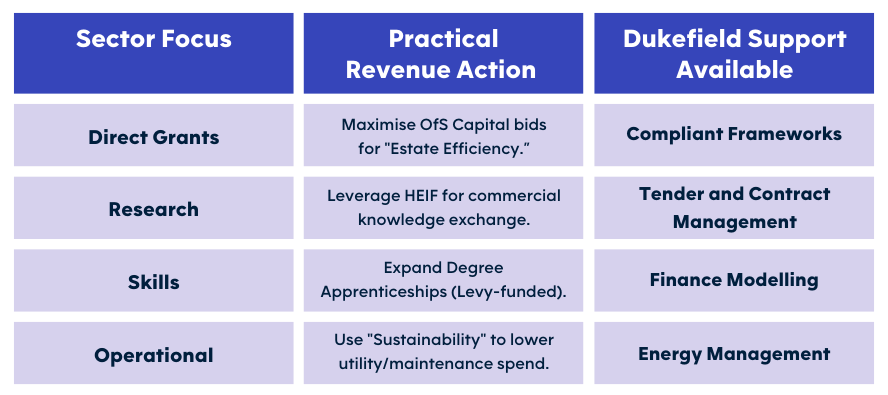
The Dukefield Perspective
Diversifying income isn't just a finance task; it’s a procurement and estates task. You cannot build a resilient future on an inefficient foundation.
Whether you are looking to strengthen income streams or make your capital funding go further, our procurement frameworks are here to support you. Contact the team today:
Email claire.makin@dukefield.co.uk
Phone 01204 374 156